When Can a Baby Sleep With a Blanket? Safe Age, Guidelines, and Alternatives
When Can a Baby Safely Sleep With a Blanket?
The American Academy of Pediatrics (AAP) recommends keeping all loose blankets, pillows, quilts, comforters, and soft bedding out of a baby‘s sleep space until at least 12 months of age. Most pediatric sleep experts consider 18 months the safer benchmark, and many recommend waiting until age 2 for thicker or weighted blankets.
The reasoning is straightforward: babies under 1 lack the motor skills, neck strength, and arousal responses to reliably move bedding away from their face. Loose blankets are a leading contributor to sudden unexpected infant death (SUID), accidental suffocation, and strangulation in sleep environments. After the first birthday, the risk drops significantly because most toddlers can roll, lift their heads, push objects away, and wake more reliably from airway obstruction.
Why Blankets Are Dangerous Before 12 Months
Loose bedding raises the risk of suffocation, rebreathing of carbon dioxide, overheating, and entanglement. According to the National Institute of Child Health and Human Development, soft bedding contributes to roughly two-thirds of sleep-related infant deaths, and blankets are one of the most commonly involved items.
The Four Key Risks
- Suffocation: A blanket pulled over the nose and mouth can block airflow within minutes. Newborns under 4 months cannot lift or turn their heads efficiently to clear obstructions.
- Rebreathing CO₂: When fabric traps exhaled air near the face, oxygen levels drop and carbon dioxide accumulates, which can cause a fatal cascade in babies with immature arousal reflexes.
- Overheating (hyperthermia): Babies regulate temperature poorly. Excess heat is an independent risk factor for SIDS, and adult-style blankets trap significantly more warmth than infant sleepwear is designed for.
- Strangulation and entanglement: Long blankets can wrap around the neck or limbs, especially once a baby starts rolling or pulling themselves up in the crib.
The Official Age Guidelines From Major Health Organizations
Health authorities worldwide converge on 12 months as the minimum age, with stronger recommendations for waiting longer when possible. The exact wording varies, but the safety floor is consistent.
| Organization | Recommendation | Year Updated |
|---|---|---|
| American Academy of Pediatrics (AAP) | No loose bedding under 12 months | 2022 |
| NHS (United Kingdom) | No pillows or duvets under 12 months; lightweight blanket tucked below shoulders acceptable from birth if firm | 2023 |
| Red Nose (Australia) | Sleeping bag preferred; tucked-in light blanket acceptable, no loose bedding | 2023 |
| Canadian Paediatric Society | No blankets, pillows, or bumpers under 12 months | 2021 |
| WHO Safe Sleep Guidance | Firm flat surface, no soft objects, until at least 1 year | 2022 |
Why 12 Months Is the Turning Point
By the first birthday, most babies have developed the physical and neurological capacity to protect their own airway during sleep. They can roll both ways, push objects off their face, sit up, and wake more easily when breathing is restricted. SIDS risk also drops dramatically after 6 months and becomes statistically rare after 12 months.
Developmental Milestones That Reduce Risk
- Independent rolling (4–7 months): Reduces but doesn’t eliminate suffocation risk.
- Sitting unassisted (6–9 months): Indicates strong core and neck control.
- Pulling to stand (9–12 months): Shows mature gross-motor coordination.
- Purposeful grasp and release (10–12 months): Allows baby to actively move a blanket aside.
- Improved arousal response: By 12 months, sleep architecture matures so babies wake more readily from mild airway compromise.
What to Use Instead of a Blanket Before Age 1
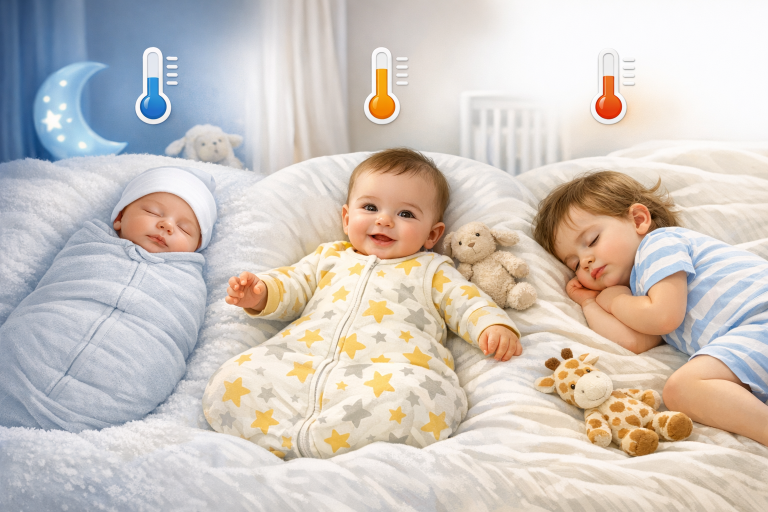
Wearable blankets, sleep sacks, and footed pajamas are the safest options for infants who need warmth. They provide insulation without any loose fabric near the face, and they cannot be kicked off or pulled over the head.
Best Alternatives by Age
- 0–2 months: Swaddle (arms in) using a thin muslin or a Velcro/zip swaddle like Halo SleepSack or Love to Dream. Stop swaddling at the first signs of rolling, typically by 8 weeks.
- 2–6 months: Transitional sleep sack with arms free (e.g., Merlin’s Magic Sleepsuit or Love to Dream Stage 2).
- 6–12 months: Standard sleep sack rated by TOG (Thermal Overall Grade). Use 0.5 TOG for rooms above 75°F (24°C), 1.0 TOG for 69–74°F (20–23°C), and 2.5 TOG for cooler rooms below 68°F (20°C).
- 12+ months: Sleep sack or a small, lightweight cotton or muslin blanket if introducing bedding.
Room Temperature Matters More Than Bedding
The AAP recommends keeping the nursery between 68°F and 72°F (20–22°C). Dressing your baby in one more layer than you are wearing is a reliable rule of thumb. Overheating signs include sweating, damp hair, flushed cheeks, rapid breathing, and a hot chest or back.
How to Safely Introduce a Blanket After 12 Months
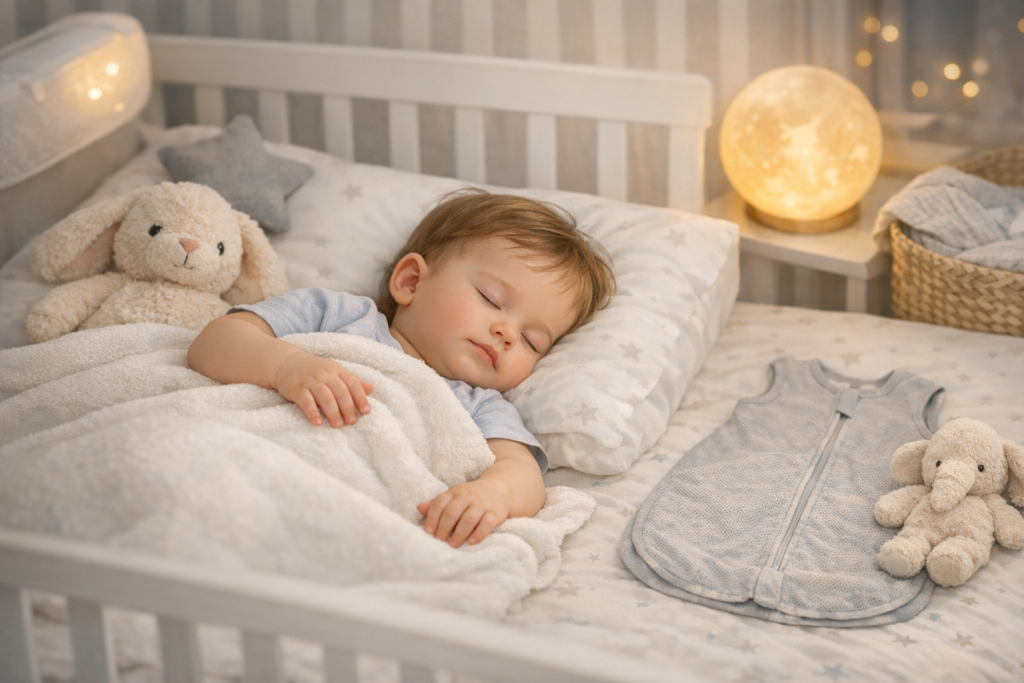
Once your child turns 1, introduce a blanket gradually and choose one that is small, breathable, and lightweight. Avoid heavy quilts, weighted blankets, comforters with loose stuffing, and anything larger than the crib mattress until at least age 2.
Step-by-Step Introduction
- Choose the right blanket: A thin cotton, muslin, or knit blanket no larger than 40 x 40 inches.
- Start during naps: Introduce it during supervised daytime sleep before overnight use.
- Tuck it in: Place the blanket up to the chest with arms out, and tuck the lower edge under the mattress (the “feet-to-foot” position the NHS recommends).
- Skip the pillow: Pillows aren’t recommended until 18–24 months and aren’t necessary for healthy spinal development in toddlers.
- Monitor temperature: Check the back of the neck. If sweaty, remove a layer.
Sleep Sack vs. Blanket: A Direct Comparison
Sleep sacks remain safer than blankets even after age 1, and many children continue using them until age 3 or beyond. They eliminate the cold-feet problem when blankets get kicked off and remove suffocation risk entirely.
| Factor | Sleep Sack | Loose Blanket |
|---|---|---|
| Suffocation risk | None | Present until ~12 months |
| Stays in place | Yes | No, often kicked off |
| Temperature control | TOG-rated, predictable | Variable |
| Climb-out prevention | Yes (restricts leg lift) | No |
| Sleep cue association | Strong | Weak |
Common Mistakes Parents Make With Infant Bedding
Even well-informed parents make subtle errors that increase risk. Awareness of these pitfalls helps maintain a safe sleep environment throughout infancy.
- Using crib bumpers: Banned by federal law in the U.S. as of 2022 under the Safe Sleep for Babies Act.
- Adding “just one small blanket” for cold nights: Even a receiving blanket can pose suffocation risk under 12 months. Use a warmer-rated sleep sack instead.
- Letting baby sleep with a lovey under 12 months: Small comfort objects should also wait until age 1.
- Tucking baby in with parents’ bedding: Bed-sharing with adult blankets dramatically increases SIDS risk.
- Using weighted swaddles or weighted sleep sacks: The AAP explicitly advises against these because they can restrict breathing and movement.
- Layering too many sleep sacks: Doubling up disrupts the TOG rating and can cause overheating.
When Are Pillows, Comforters, and Stuffed Animals Safe?
Pillows and comforters should wait until at least 18 months, and ideally age 2. Stuffed animals follow the same 12-month minimum as blankets, with small, firm, breathable toys preferred for younger toddlers.
Recommended Timeline
- 12 months: Small, thin blanket and one small stuffed animal.
- 18 months: Toddler-sized pillow (flat, no thicker than 3–4 inches).
- 2 years: Standard comforter or duvet, full bedding setup once moved to a toddler bed.
- 3+ years: Weighted blanket (no more than 10% of body weight, only with pediatrician approval).
Frequently Asked Questions
Can my 6-month-old sleep with a blanket if they can roll over?
No. Rolling is a positive developmental milestone, but it doesn’t eliminate suffocation risk from loose bedding. A 6-month-old still lacks the consistent strength and judgment to clear a blanket from their airway during deep sleep. The 12-month minimum applies regardless of motor milestones, and pediatric organizations have not adjusted this recommendation based on rolling ability.
Is it safe to use a blanket in the stroller or car seat?
Only when you are actively supervising and the baby is awake. For sleeping infants in strollers or car seats, use a footmuff or have the baby wear warm clothing instead. Never place a blanket over the top of a car seat where it could fall onto the baby’s face, and avoid bulky outerwear under the car seat harness because it compresses in a crash.
What if my baby gets cold at night without a blanket?
Use a higher-TOG sleep sack and add a layer of footed pajamas underneath. A long-sleeve cotton bodysuit plus fleece footed pajamas plus a 2.5 TOG sleep sack will keep a baby warm in rooms as cool as 61°F (16°C). Check the back of the neck or chest, not the hands and feet, to assess actual body temperature.
Are muslin blankets safer than regular blankets?
Muslin is more breathable than fleece or knit fabric, but it is still not safe for unsupervised sleep under 12 months. Breathability reduces but does not eliminate suffocation and rebreathing risks. Muslin is excellent for swaddling newborns, burp cloths, stroller covers during supervised use, and as a first introductory blanket after the first birthday.
When can my child use a weighted blanket?
Weighted blankets are generally not recommended before age 3, and many occupational therapists wait until age 5 or older. The blanket should weigh no more than 10% of the child’s body weight, and it should never restrict their ability to remove it. Children with sleep apnea, low muscle tone, or respiratory conditions should not use weighted blankets without medical clearance.
Can I let my 1-year-old sleep with a blanket and a stuffed animal?
Yes, after 12 months you can introduce one small, thin blanket and one small, firm stuffed animal. Avoid large plush toys, anything with button eyes or removable parts, and bedding bigger than the crib mattress. Many parents find a single “lovey” (a small comfort object) provides more soothing benefit than a blanket and stays put through the night.
Does swaddling count as a blanket?
A proper swaddle is not a loose blanket — it’s a fitted wrap that immobilizes the arms and stays secure. Swaddling is safe from birth until the first signs of rolling, usually 8–12 weeks. Once your baby shows any attempt to roll, stop swaddling immediately and transition to an arms-out sleep sack, because a rolled, swaddled baby cannot push up or reposition.
What is the safest sleep setup for a baby under 12 months?
A firm, flat crib mattress with a fitted sheet only, baby on their back, in a sleep sack appropriate for room temperature, in a room between 68–72°F, with no pillows, blankets, bumpers, positioners, or stuffed animals. Room-sharing without bed-sharing for the first 6–12 months reduces SIDS risk by up to 50% according to AAP data.