How Loud Should Baby White Noise Be? The Complete Decibel Safety Guide
The Short Answer: Safe Volume Levels for Baby White Noise
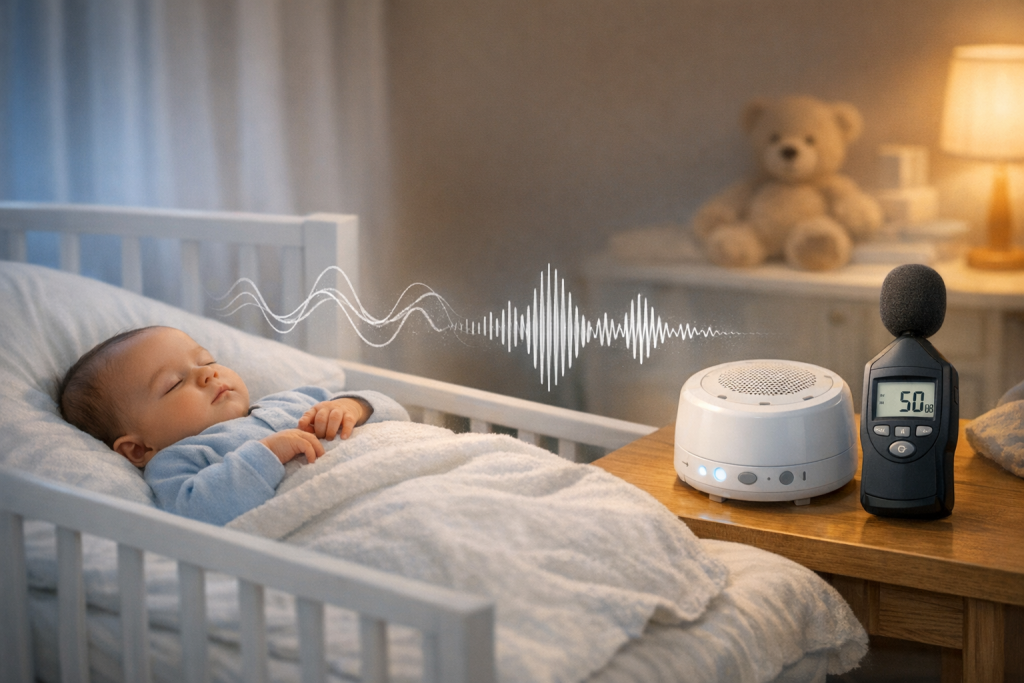
Baby white noise should be played at no more than 50 decibels (dB) — roughly the volume of a quiet refrigerator or light rainfall — measured at the baby’s ear or crib mattress, not at the machine itself. The American Academy of Pediatrics (AAP) recommends keeping sound machines at least 7 feet (200 cm) from the crib and using them on the lowest effective setting.
This 50 dB ceiling comes from a landmark 2014 study published in Pediatrics by Dr. Blake Papsin at the Hospital for Sick Children in Toronto, which tested 14 infant sound machines and found 3 of them produced over 85 dB at 30 cm — louder than a hairdryer and capable of causing noise-induced hearing loss with extended exposure.
Why 50 Decibels Is the Accepted Safety Threshold
The 50 dB limit is borrowed directly from hospital NICU guidelines established by the Environmental Protection Agency (EPA) and the American Academy of Pediatrics, which cap continuous noise exposure for infants at 45–50 dB to protect developing auditory pathways and support healthy sleep architecture.
Decibels operate on a logarithmic scale, so the difference between safe and unsafe is smaller than it sounds:
- 30 dB — A whisper or quiet bedroom at night
- 50 dB — Recommended ceiling for infant white noise; equivalent to moderate rainfall
- 60 dB — Normal conversation; already too loud for prolonged infant exposure
- 70 dB — Vacuum cleaner; risk of auditory fatigue
- 85 dB — OSHA’s threshold for adult hearing damage with 8-hour exposure
- 100+ dB — Several popular sound machines tested at maximum volume close to crib
Because babies have smaller ear canals, sound pressure resonates more intensely at their eardrums than at an adult’s — meaning a “comfortable” volume to you may already be excessive for them.
How to Measure White Noise Volume Accurately
The most reliable way to measure white noise volume is with a calibrated sound level meter or a smartphone decibel app held at the baby’s head position inside the crib, with the machine running at its intended placement and volume. Free apps like NIOSH Sound Level Meter (iOS) and Sound Meter (Android) are accurate to within 2 dB when used with proper microphone calibration.
Step-by-Step Measurement Protocol
- Place the sound machine where you intend to use it permanently (typically 7+ feet from crib).
- Set it to the volume you normally use during sleep.
- Open your decibel meter app and let it calibrate for 10 seconds.
- Hold the phone at the height of the crib mattress, where the baby’s head rests.
- Record the average reading over 30 seconds — not the peak.
- Adjust volume or distance until the average sits between 45–50 dB.
If your reading exceeds 50 dB, either lower the volume or move the device farther away. Doubling the distance from the source typically reduces sound pressure by about 6 dB.
Distance Matters as Much as Volume
Distance is the single most important variable in white noise safety because sound intensity drops by approximately 6 dB every time you double the distance from the source. A machine measuring 75 dB at 1 foot will register roughly 63 dB at 4 feet and 51 dB at 8 feet.
The Papsin study specifically recommended placing sound machines at least 200 cm (about 6.5–7 feet) from the crib, never inside the crib, and never mounted to the crib rail. Yet many popular consumer products — including plush “sleep sheep” devices and crib-attachable soothers — are designed to sit inches from the baby’s ear, where even moderate volume settings can exceed 85 dB.
| Distance from Machine | Typical Reading (Machine at “Medium”) |
|---|---|
| 30 cm (12 in) | 75–85 dB |
| 1 m (3.3 ft) | 65–72 dB |
| 2 m (6.5 ft) | 55–62 dB |
| 3 m (10 ft) | 48–55 dB |
Comparing Popular Sound Machines
Not all white noise machines are equal — output ranges, frequency profiles, and maximum volumes vary widely. The Hatch Rest, for example, maxes out around 70 dB at 1 foot, while the Marpac Dohm (a mechanical fan-based unit) tops out near 60 dB, making it inherently safer at any setting. Some smartphone apps paired with full-volume Bluetooth speakers can exceed 90 dB, posing the greatest risk.
What to Look For When Buying
- Maximum output below 70 dB at 1 foot — provides a built-in safety margin
- Continuous (non-looping) sound — looping audio can wake babies at the loop point
- Timer function — runs only during sleep onset rather than all night (debated; see below)
- Pink noise option — softer high-frequency content, often more soothing than pure white noise
- Volume lock or child-safe controls — prevents accidental volume spikes
White Noise vs. Pink Noise vs. Brown Noise for Babies
White noise contains equal energy across all audible frequencies and sounds like television static; pink noise reduces high-frequency energy and resembles steady rainfall; brown noise emphasizes low frequencies and sounds like distant thunder. For infants, pink noise is increasingly recommended because it mimics intrauterine sounds (which measure around 70–95 dB in the womb but are heavily low-pass filtered by amniotic fluid and tissue).
Regardless of color, the 50 dB external limit still applies — the in-womb comparison is misleading because the baby is no longer surrounded by fluid that filters out damaging high frequencies.
Should White Noise Play All Night?
Most pediatric sleep specialists recommend playing white noise continuously through the entire sleep period rather than using a timer, because abrupt cessation can wake light sleepers during natural sleep-cycle transitions (roughly every 45–60 minutes in infants). However, the volume should be reduced once the baby is asleep if possible.
Dr. Harvey Karp, author of The Happiest Baby on the Block, recommends using louder white noise (around 65–70 dB) only during active soothing of a crying newborn — comparable to the in-womb experience — then reducing to 50 dB or below for sustained sleep. This “two-stage” approach balances calming efficacy with auditory safety.
Risks of White Noise That’s Too Loud
Excessive white noise exposure poses three documented risks to infants: noise-induced hearing loss, delayed auditory cortex development, and disrupted speech processing. A 2003 study in Science by Dr. Edward Chang at UCSF demonstrated that rats raised in continuous white noise showed delayed maturation of the auditory cortex, raising concerns about long-term exposure in humans.
Warning Signs Volume Is Too High
- You need to raise your voice to talk over it in the nursery
- You can hear it clearly from outside the closed nursery door
- Baby startles or flinches when the machine turns on
- You’re using a phone speaker or smart speaker at more than 50% volume
- The machine is within arm’s reach of the crib
Common Mistakes Parents Make
The most frequent errors include placing the machine on the crib rail, cranking volume to drown out household noise, leaving it at “soothing” newborn volume long after the baby is older, and trusting machine labels like “lullaby mode” without measuring actual output.
- Putting the machine in the crib. Even on low settings, output at 6 inches can exceed 85 dB.
- Using a tablet or phone at full volume. Most consumer speakers were never designed for continuous overnight use and have unpredictable output curves.
- Compensating for daytime noise. If your nursery is noisy, address the source rather than raising white noise volume — masking loud sounds with louder sounds doubles the exposure.
- Never measuring. Manufacturer “volume levels” are not standardized; only direct dB measurement tells you the truth.
- Forgetting to recheck. As your baby grows and moves around the crib, their distance from the machine changes.
Adjusting Volume by Age
Newborns (0–3 months) tolerate slightly louder white noise (up to 60–65 dB during soothing) because of recent in-utero acoustic conditioning, while infants 3+ months should sleep with white noise at or below 50 dB. By 12 months, many sleep consultants recommend gradually weaning if the child no longer needs it, though continued use at safe volumes carries no documented harm.
Frequently Asked Questions
Is 60 dB too loud for baby white noise during sleep?
For sustained overnight sleep, 60 dB is at the upper edge of acceptable and slightly above the AAP-endorsed 50 dB target. It’s roughly the volume of normal conversation. Short-term use at 60 dB during active soothing of a crying newborn is generally considered safe, but for an all-night setting, aim lower. If your meter consistently reads 60 dB at the crib, move the machine farther away or reduce volume by one level.
Can white noise damage my baby’s hearing?
Yes, if played too loudly or too close. Sustained exposure above 85 dB can cause noise-induced hearing loss in infants, whose ear canals amplify sound more than adults’. The 2014 Papsin study found that three of 14 commercial baby sound machines exceeded this threshold when placed near the crib at maximum volume. Following the 50 dB / 7-foot rule eliminates virtually all documented hearing risk.
How can I tell if white noise is at 50 decibels without a meter?
A practical rule of thumb: if the white noise is about as loud as a steady shower heard from the next room, or a soft rainfall, you’re close to 50 dB. You should be able to speak in a normal voice over it without raising your volume, and it should not be audible from outside the closed nursery door. That said, a free smartphone decibel app gives a far more accurate reading and costs nothing.
Should I turn off white noise once my baby falls asleep?
Most sleep experts recommend keeping it on through the entire sleep period because infants cycle through light sleep every 45–60 minutes and can wake when background sound suddenly stops. Continuous playback at a safe 45–50 dB volume is preferable to a timer that shuts off mid-sleep. The exception is if you’re using elevated volume (65+ dB) for active soothing — in that case, reduce volume once the baby is settled.
Is brown noise or pink noise safer than white noise for babies?
Safety depends on volume and distance, not the type of noise — all three are safe at 50 dB and below. However, pink and brown noise are often perceived as gentler because they de-emphasize high frequencies that can be harsher on developing ears. Many parents find babies settle equally well with pink noise played at a lower absolute volume, which is the ideal combination.
Can I use my phone as a white noise machine?
Yes, but with caution. Phone speakers vary enormously in output, and many apps default to high volumes. Use a decibel meter to measure actual output at the crib, set volume to no more than 30–40% of maximum, and place the phone at least 7 feet away. Avoid pairing with high-powered Bluetooth speakers unless you can verify the dB level. Also disable notifications, which can spike volume unexpectedly.
At what age should I stop using white noise?
There’s no medically required cutoff — white noise at safe volumes is not harmful at any age. Many families continue using it for toddlers and even adults. However, some sleep consultants recommend weaning between 12 and 24 months to prevent dependency, particularly if the child sleeps elsewhere occasionally. If your child sleeps well with it and you’ve maintained safe volume levels, there’s no urgent reason to stop.